

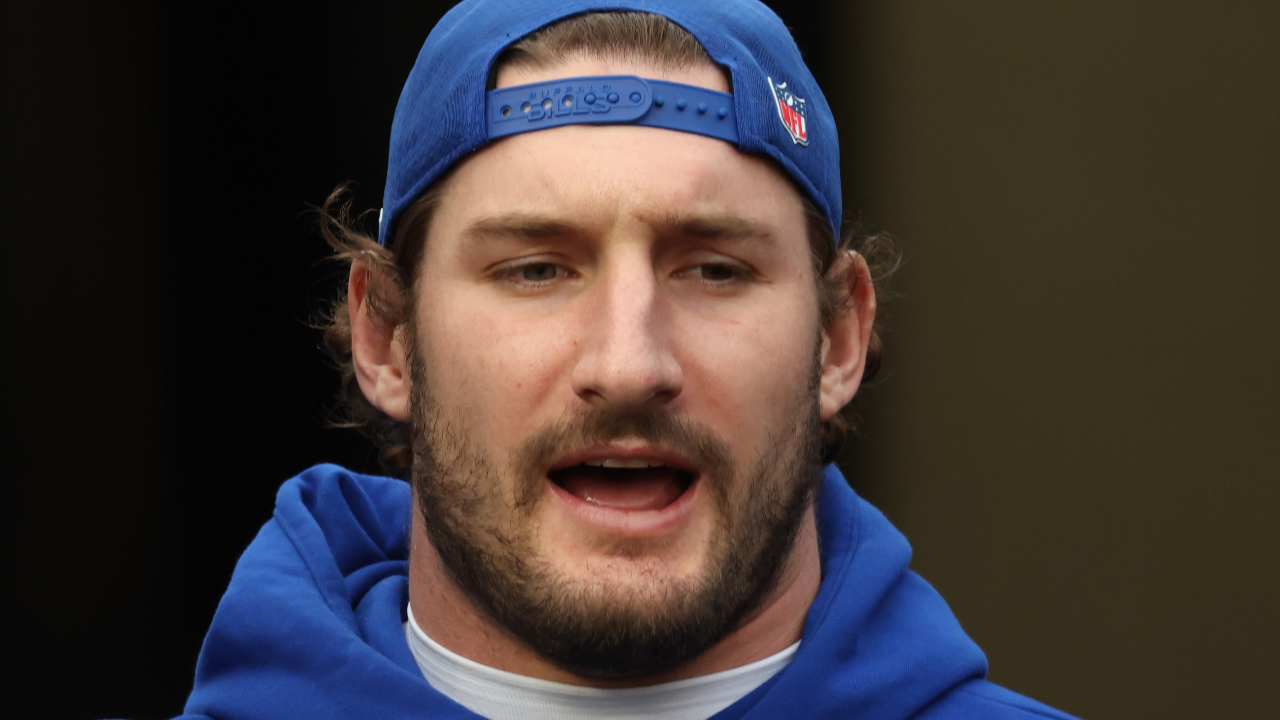
Somewhere in the 49ers’ front office, a phone keeps not ringing. Joey Bosa, one of the best edge rushers still available in 2026 free agency, sits without a contract. San Francisco sits on roughly $67.4 million in available salary cap space, the largest war chest in the NFL. They need a pass rusher. He is a pass rusher. The brother of their best defensive player. And yet weeks into free agency, the two sides remain miles apart on money. That gap tells a bigger story than any sack total ever could.
The Pass Rush That Fell Apart

Buffalo Bills defensive end Joey Bosa watches the offensive line on the field during second half action against the Tampa Bay Buccaneers on Nov 16, 2025 at Highmark Stadium in Orchard Park.
The 49ers entered this offseason with edge rusher flagged as a top priority by analysts and insiders. Then Bryce Huff retired at 27 in March 2026, ripping another body off an already thin edge rotation. San Francisco entered free agency with a gaping hole where its defensive identity used to live. The fan base knew it. Every mock draft and free-agent tracker pointed to the same conclusion: this team needed to add a premium pass rusher, and it needed to do it fast. The cap room to do it already existed.
Engineering a Fortune

Dec 28, 2025; Orchard Park, New York, USA; Philadelphia Eagles quarterback Jalen Hurts (1) is chased out of the pocket by Buffalo Bills linebacker Terrel Bernard (8) and defensive end Joey Bosa (97) in the second quarter at Highmark Stadium. Mandatory Credit: Mark Konezny-Imagn Images
This cap surplus didn’t happen by accident. The 49ers restructured Nick Bosa’s contract, converting $21.4 million of salary into a signing bonus and freeing roughly $17.1 million in 2026 cap relief by pushing a massive hit into 2027. They also received more than $20 million in additional cap credits, with SF Chronicle reporting a $20.65 million cap adjustment. Analysts described the result as a “ton of short-term flexibility.” With the NFL’s projected salary cap just over $300 million, San Francisco now controls roughly one-fifth of a full cap in open room. That kind of manufactured firepower usually precedes a blockbuster move. Usually.
The Price They Refuse to Pay

Philadelphia Eagles tight end Dallas Goedert is stopped from going into the end zone by Buffalo Bills cornerback Taron Johnson, cornerback Maxwell Hairston and defensive end Joey Bosa during first half action against the Philadelphia Eagles at Highmark Stadium in Orchard Park on Dec. 28, 2025.
Joey Bosa played 2025 on a one-year, roughly $13 million deal with the Bills. The 49ers could absorb that several times over. They chose not to. Reports describe San Francisco as refusing to meet Bosa’s asking price and unwilling to overspend simply because cap space exists. General manager John Lynch said it plainly: “I don’t know if we can afford him.” A team with $67.4 million in cap space, claiming it can’t afford a pass rusher who played last year for $13 million.
The Valuation Model Wins

Nov 2, 2025; Orchard Park, New York, USA; Kansas City Chiefs quarterback Patrick Mahomes (15) is brought down by Buffalo Bills defensive end Greg Rousseau (50) and defensive end Joey Bosa (97) in the first quarter at Highmark Stadium. Mandatory Credit: Mark Konezny-Imagn Images
Lynch’s comment wasn’t a slip. It was a philosophy statement. NBC Sports Bay Area’s Matt Maiocco summarized it bluntly: the 49ers are not going to increase what they’re prepared to offer Bosa or any free agent simply because they have salary cap space. Bosa is 30, turning 31 during the 2026 season, with a real injury history. San Francisco’s front office is telling the entire league that its internal valuation models matter more than sentiment, more than the family storyline, more than the optics of hoarding cap space while the defense bleeds. That’s either disciplined or delusional, and the season will decide which.
The Numbers Behind the Standoff

Oct 26, 2025; Charlotte, North Carolina, USA; Carolina Panthers quarterback Andy Dalton (14) passes against Buffalo Bills defensive tackle Ed Oliver (91), defensive end Michael Hoecht (55) and defensive end Joey Bosa (97) in the second quarter at Bank of America Stadium. Mandatory Credit: Bob Donnan-Imagn Images
Consider the math. The 49ers rank first in the NFL in cap room, with estimates ranging from $67.4 million to nearly $70 million. Bosa’s likely price represents a small fraction of that available space. San Francisco could sign him tomorrow, still have well over $50 million left, and remain among the league’s most flexible teams. Instead, they’re rolling unused space forward and patching the edge with cheaper options. Like a homeowner with a massive credit line watching the fence rot because the contractor’s bid came in too high.
The Bosa Reunion That Won’t Happen

Sep 7, 2025; Orchard Park, New York, USA; Buffalo Bills defensive end Joey Bosa (97) warms up prior to the game against the Baltimore Ravens at Highmark Stadium. Mandatory Credit: Mark Konezny-Imagn Images
The family angle makes this sting more. Nick Bosa anchors San Francisco’s defensive line. Joey Bosa, his older brother, is the most obvious edge complement on the open market. Insiders say the 49ers are not budging even with all that cap room, and Maiocco does not see San Francisco raising its offer. The 49ers restructured Nick’s deal to create flexibility, then used that flexibility to not sign Nick’s brother. The ripple effect extends beyond one roster spot. If San Francisco won’t pay a premium edge rusher with this much room, the entire free-agent market recalibrates downward.
A New Rule for Cap-Rich Teams

Oct 13, 2025; Atlanta, Georgia, USA; Buffalo Bills defensive end Joey Bosa (97) attempts to tackle Atlanta Falcons running back Bijan Robinson (7) during the first half of a game at Mercedes-Benz Stadium. Mandatory Credit: Dale Zanine-Imagn Images
This standoff sets a precedent that reaches beyond one player and one team. Cap-rich contenders used to spend big on marquee free agents because they could. The 49ers are proving that “can” and “will” are different words. Sports Illustrated explicitly asked “Why the 49ers Haven’t Signed Joey Bosa Yet,” and the answer keeps coming back the same: they believe patience and value discipline beat urgency. Once you see that framework, every team’s offseason spending looks different. Having cap space no longer means having intent to use it.
The Clock Nobody Mentions

Sep 21, 2025; Santa Clara, California, USA; San Francisco 49ers defensive end Nick Bosa (97) on the field during warm ups prior to a game against the Arizona Cardinals during the first half at Levi’s Stadium. Mandatory Credit: Cary Edmondson-Imagn Images
Nick Bosa’s restructured deal pushed a massive cap hit into 2027, ballooning his future cap number well above $50 million. That means the 49ers’ current flexibility has an expiration date. The window to spend this money and field a complete roster is narrower than the raw number suggests. Every week they hold $67.4 million without addressing the edge rotation, the competitive window shrinks. Bosa’s market remains quiet, with analysts noting his age and the lack of bidding wars. But quiet markets don’t stay quiet forever, and neither do division rivals loading up.
What Lynch Is Really Betting On

Sep 28, 2025; Santa Clara, California, USA; San Francisco 49ers general manager John Lynch (left) talks with cornerback Eli Apple (right) before the game against the Jacksonville Jaguars at Levi’s Stadium. Mandatory Credit: Darren Yamashita-Imagn Images
John Lynch said he’d make “Mama Bosa happy” if he could, then explained why he wouldn’t. SI suggests the 49ers may circle back with a one-year offer in July, betting Bosa’s market softens before their need becomes desperate enough to overpay. They’re betting that a 30-year-old edge rusher with an injury history blinks before a front office sitting on a league-leading cap surplus does. If they’re right, they get their pass rusher at a discount and look like geniuses. If they’re wrong, they spent an entire offseason proving that having money and spending it are two completely different things. What would you do if you were John Lynch — hold the line and trust the valuation model, or write the check and bring Joey home to play next to Nick? Drop your call in the comments.