


The governor stood at a podium with days left in the legislative session and invoked the supernatural. “I’ve seen miracles happen every year,” J.B. Pritzker told reporters, referring to a stadium bill that could lock Illinois into a 40-year tax arrangement with a single NFL franchise. Somewhere in Arlington Heights, 326 acres of dirt sat waiting for a decision. Somewhere in Hammond, Indiana, a stadium authority already had the green light. The miracle Pritzker needed had a price tag most people hadn’t seen yet.
Two States, One Franchise, Zero Leverage

Chicago Bears wide receiver DJ Moore (2) runs for a touchdown in the fourth quarter of the NFL football game between Chicago Bears and Cincinnati Bengals at Paycor Stadium in Cincinnati on Nov. 2, 2025.
Indiana’s House Ways and Means Committee advanced its stadium bill 24–0. Unanimous. The full Indiana House then approved Senate Bill 27 by a 95–4 vote, creating a Northwest Indiana Stadium Authority empowered to acquire land, issue bonds, and close a deal the moment the Bears said yes. Illinois, meanwhile, spent more than three years letting its megaprojects bill collect dust before the threat of losing the franchise forced a vote. The Illinois House passed House Bill 910 on a 78–32 margin, but the Bears wanted changes. One state had a finished product. The other was still negotiating the rough draft.
The Promise That Started It All

Detroit Lions wide receiver Amon-Ra St. Brown and running back David Montgomery celebrate the 31-26 win over the Chicago Bears at Ford Field in Detroit on Sunday, Nov. 19, 2023.
Bears President Kevin Warren published an open letter pledging the franchise would build a “world-class” stadium requiring “zero state money for construction.” Fans heard that and exhaled. Politicians pointed to it as proof the deal was fair. The assumption was simple: the Bears pay for the building, taxpayers get the jobs. That framing held together right up until the infrastructure number surfaced. The team was simultaneously seeking roughly $855 million in public funding for roads, utilities, and site work around that same stadium.
The $39 Million Gap Nobody Advertised

May 22, 2026; Chicago, Illinois, USA; Chicago Bears first-round draft pick Dillon Thieneman jokes with Cubs mascot Clark before throwing out a ceremonial first pitch before a baseball game between the Chicago Cubs and Houston Astros at Wrigley Field. Mandatory Credit: Kamil Krzaczynski-Imagn Images
The Cook County treasurer’s office ran the numbers. A $2 billion stadium, fully assessed, would generate roughly $53 million in annual property taxes. Under the megaprojects bill, the Bears would pay approximately $14 million: $4 million in frozen-assessment taxes plus a $10 million PILOT. That leaves a $39 million annual gap. Over 40 years, the projected savings exceed $1.5 billion. For the Bears. The average Arlington Heights homeowner would see about $300 a year in relief. One franchise’s annual tax break equals roughly 130,000 of those homeowner checks.
How the Parallel Tax System Works

May 8, 2026; Lake Forest, IL, USA; Chicago Bears wide receiver Zavlon Thomas (81) stretches during Rookie Minicamp at Halas Hall. Mandatory Credit: Kamil Krzaczynski-Imagn Images
The mechanism is elegant and buried in legislative language. The megaprojects bill freezes a property’s assessed value before construction begins, then allows the developer to negotiate a PILOT instead of paying rising taxes on the finished project. Lawmakers added sales tax exemptions on construction materials through the High Impact Business Program. So the Bears would dodge the normal property tax system, lock in a discounted rate for four decades, and save on building costs upfront. Everyone else stays in the old system, where assessments climb and bills follow.
The Relief That Isn’t

Green Bay Packers wide receiver Jayden Reed (11) scores a toucdown against Chicago Bears linebacker Tremaine Edmunds (49) during their wild-card playoff football game Saturday, January 10, 2026, at Soldier Field in Chicago, Illinois. Wm. Glasheen /USA TODAY NETWORK-Wisconsin.
Lawmakers built a relief provision into the bill: 50% of PILOT receipts go to property tax relief, with 60% of that share directed to residential homeowners in affected districts. Sounds generous until you do the math. CBS Chicago reported that Arlington Heights homeowners might see roughly $300 or less annually. Homeowners elsewhere in Illinois would see almost nothing. That $300 is closer to one month of a cell phone bill than meaningful tax reform. The bill’s loudest selling point, property tax relief, delivers its smallest benefit to the people it claims to protect.
Schools and Services Pick Up the Tab

May 8, 2026; Lake Forest, IL, USA; Chicago Bears tight end Sam Roush (87) speaks during Rookie Minicamp at Halas Hall. Mandatory Credit: Kamil Krzaczynski-Imagn Images
When a $2 billion property generates $39 million less per year than it should, that revenue doesn’t vanish quietly. School districts and local governments around Arlington Heights could face long-term constraints, forcing higher levies on non-megaproject properties or cuts to services. Other large developers will immediately explore megaproject status, and a seven-year sunset clause means applications could pile up fast. The bill also excludes data centers and most residential developments, concentrating the benefits among the biggest players while smaller businesses absorb the shifted burden.
A New Rule, Not an Exception
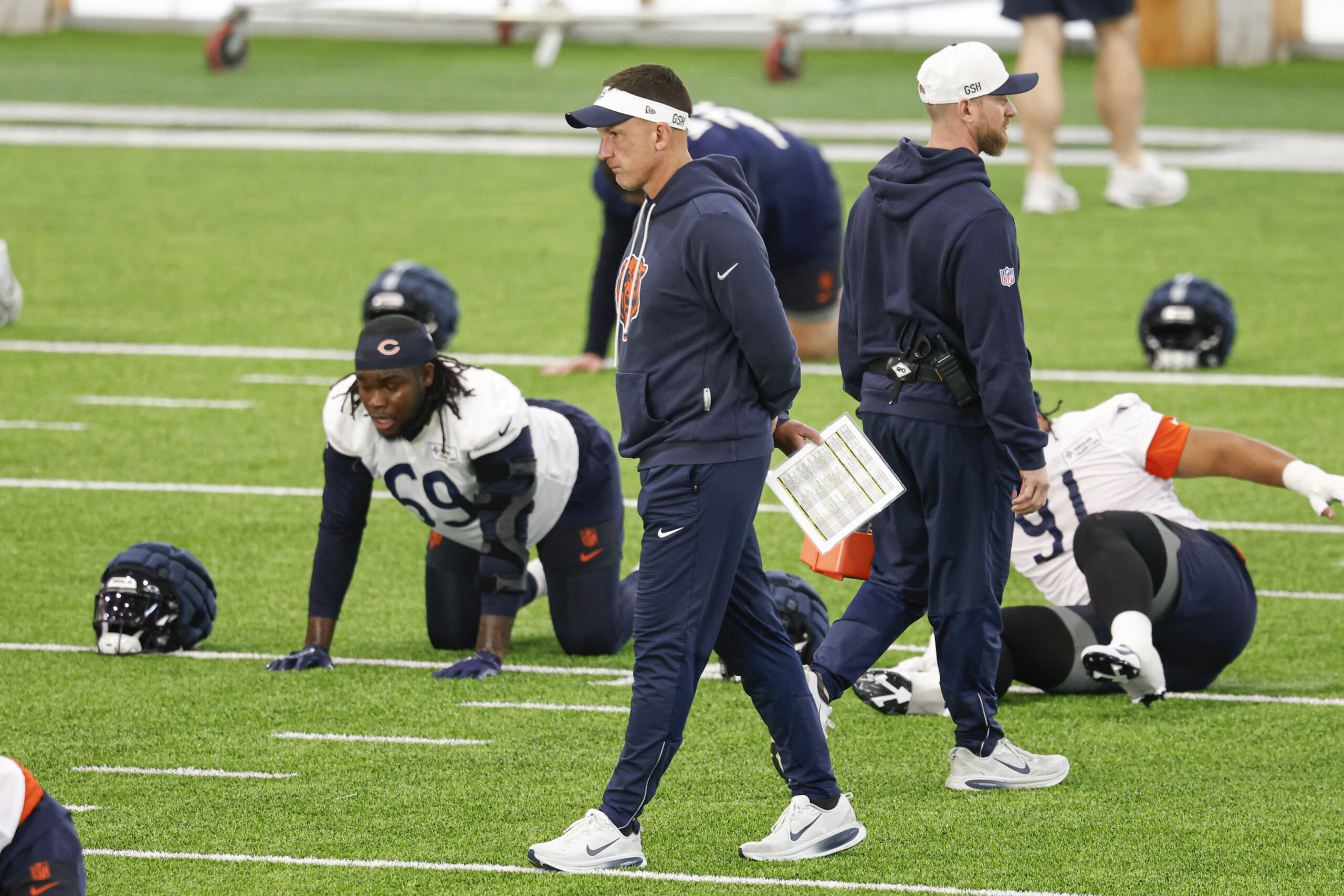
May 8, 2026; Lake Forest, IL, USA; Chicago Bears defensive coordinator Dennis Allen walks on the field during Rookie Minicamp at Halas Hall. Mandatory Credit: Kamil Krzaczynski-Imagn Images
The amended megaprojects bill grew to roughly ten times the length of its earlier version. It created tiered thresholds where projects investing $1 billion or more qualify for 40-year PILOT agreements. This framework normalizes multidecade assessment freezes as the default model for mega-deals. If the Bears’ arrangement succeeds politically, every future stadium, casino, and entertainment district will point to it as precedent. Once you see how frozen assessments, PILOTs, and sales-tax exemptions interact, the stadium fight stops looking like civic pride and starts looking like a template for transferring fiscal risk from corporations to tax rolls.
The Subsidy Arms Race Has No Finish Line

Detroit Lions safety Kerby Joseph (31), left, and safety Brian Branch (32) celebrate a play against Chicago Bears during the first half at Ford Field in Detroit on Thursday, Nov. 28, 2024.
Indiana committed public bonds backed by admissions taxes, hotel stays, and food-and-beverage revenue. Illinois countered with frozen assessments and construction-material exemptions. The Bears sit between them, leveraging one state’s offer against the other. Within months, other states chasing teams or employers could feel compelled to sweeten their own packages. Reform-minded lawmakers and watchdog groups are already pushing for stricter caps on tax expenditures and independent cost-benefit analyses. The Bears claim 56,000 construction jobs and $10 billion in economic impact, but those projections come from the team itself.
The Decision Nobody Can Take Back

Green Bay Packers tight end Josh Whyle (81) runs the ball during a football game against the Chicago Bears on Dec. 7, 2025, at Lambeau Field in Green Bay, Wis. The Packers defeated the Bears 28-21.
The Bears plan to choose between Arlington Heights and Hammond by early summer. The Illinois session ends May 31. That means lawmakers have days to finalize a 40-year commitment worth billions in foregone revenue, under pressure from a franchise that promised zero state money for construction while lining up $855 million in public infrastructure funding and a property tax shield most homeowners will never touch. Knowing how the PILOT mechanics actually work makes you the person in the room who can explain who really wins. Most people still think it’s them. Arlington Heights or Hammond — which side gets the better end of this deal? Tell us in the comments.